🚚 Free Worldwide Shipping on All Orders!Shop Now
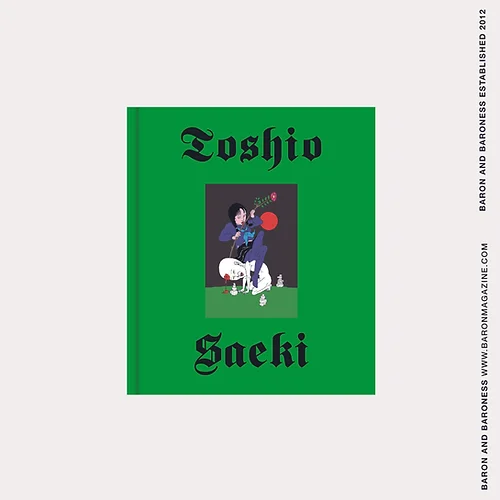

Death Book by Toshio Saeki
76 Pages
Hardback Book
First edition
32 x 28 cm
The fourth edition of The Death Book is dedicated to Japanese artist, Toshio Saeki’s (1945- 2019) archive of rarely published illustration work, that explores scenes of violence, brutality, horror and what lies beneath the surface of Japanese culture.
Hardback Book
First edition
32 x 28 cm
The fourth edition of The Death Book is dedicated to Japanese artist, Toshio Saeki’s (1945- 2019) archive of rarely published illustration work, that explores scenes of violence, brutality, horror and what lies beneath the surface of Japanese culture.
.
Saeki’s work is notable for combining traditional Shunga and Yōkai styles with elements of Western art and is characterised by eroticism, death and gore, questioning Japanese ideology and expansionism. Historian’s often describe Saeki’s work as being closely related to the Japanese cultural phenomenon ‘Erotic, Grotesque, Nonsense’ (ero, guro, nansensu).
Saeki’s work is notable for combining traditional Shunga and Yōkai styles with elements of Western art and is characterised by eroticism, death and gore, questioning Japanese ideology and expansionism. Historian’s often describe Saeki’s work as being closely related to the Japanese cultural phenomenon ‘Erotic, Grotesque, Nonsense’ (ero, guro, nansensu).
.
The book also contains an introduction by historian Euphemia Franklin.
The book also contains an introduction by historian Euphemia Franklin.
.
Artist Bio:
Born 1945, Miyazaki prefecture, Japan. Saeki's drawings are created by using an original method called “chinto printing”. This technique emphasizes the "flatness" composed of "lines" and "coloured surfaces," and gives the work a unique character.
In recent years, Saeki has had exhibits in New York, San Francisco, London, Paris, Tel Aviv, Hong Kong, Toronto, Japan, Taipei, all of them being received with much critical acclaim.
Artist Bio:
Born 1945, Miyazaki prefecture, Japan. Saeki's drawings are created by using an original method called “chinto printing”. This technique emphasizes the "flatness" composed of "lines" and "coloured surfaces," and gives the work a unique character.
In recent years, Saeki has had exhibits in New York, San Francisco, London, Paris, Tel Aviv, Hong Kong, Toronto, Japan, Taipei, all of them being received with much critical acclaim.
.
Saeki spent his later years in the mountains of Chiba prefecture, drawing, reading, enjoying ikebana of wildflowers; treasuring and loving the activities of everyday life with his wife.
Saeki spent his later years in the mountains of Chiba prefecture, drawing, reading, enjoying ikebana of wildflowers; treasuring and loving the activities of everyday life with his wife.
$18.90
Original: $63.00
-70%Death Book by Toshio Saeki—
$63.00
$18.90Product Information
Product Information
Shipping & Returns
Shipping & Returns
Description
76 Pages
Hardback Book
First edition
32 x 28 cm
The fourth edition of The Death Book is dedicated to Japanese artist, Toshio Saeki’s (1945- 2019) archive of rarely published illustration work, that explores scenes of violence, brutality, horror and what lies beneath the surface of Japanese culture.
Hardback Book
First edition
32 x 28 cm
The fourth edition of The Death Book is dedicated to Japanese artist, Toshio Saeki’s (1945- 2019) archive of rarely published illustration work, that explores scenes of violence, brutality, horror and what lies beneath the surface of Japanese culture.
.
Saeki’s work is notable for combining traditional Shunga and Yōkai styles with elements of Western art and is characterised by eroticism, death and gore, questioning Japanese ideology and expansionism. Historian’s often describe Saeki’s work as being closely related to the Japanese cultural phenomenon ‘Erotic, Grotesque, Nonsense’ (ero, guro, nansensu).
Saeki’s work is notable for combining traditional Shunga and Yōkai styles with elements of Western art and is characterised by eroticism, death and gore, questioning Japanese ideology and expansionism. Historian’s often describe Saeki’s work as being closely related to the Japanese cultural phenomenon ‘Erotic, Grotesque, Nonsense’ (ero, guro, nansensu).
.
The book also contains an introduction by historian Euphemia Franklin.
The book also contains an introduction by historian Euphemia Franklin.
.
Artist Bio:
Born 1945, Miyazaki prefecture, Japan. Saeki's drawings are created by using an original method called “chinto printing”. This technique emphasizes the "flatness" composed of "lines" and "coloured surfaces," and gives the work a unique character.
In recent years, Saeki has had exhibits in New York, San Francisco, London, Paris, Tel Aviv, Hong Kong, Toronto, Japan, Taipei, all of them being received with much critical acclaim.
Artist Bio:
Born 1945, Miyazaki prefecture, Japan. Saeki's drawings are created by using an original method called “chinto printing”. This technique emphasizes the "flatness" composed of "lines" and "coloured surfaces," and gives the work a unique character.
In recent years, Saeki has had exhibits in New York, San Francisco, London, Paris, Tel Aviv, Hong Kong, Toronto, Japan, Taipei, all of them being received with much critical acclaim.
.
Saeki spent his later years in the mountains of Chiba prefecture, drawing, reading, enjoying ikebana of wildflowers; treasuring and loving the activities of everyday life with his wife.
Saeki spent his later years in the mountains of Chiba prefecture, drawing, reading, enjoying ikebana of wildflowers; treasuring and loving the activities of everyday life with his wife.